
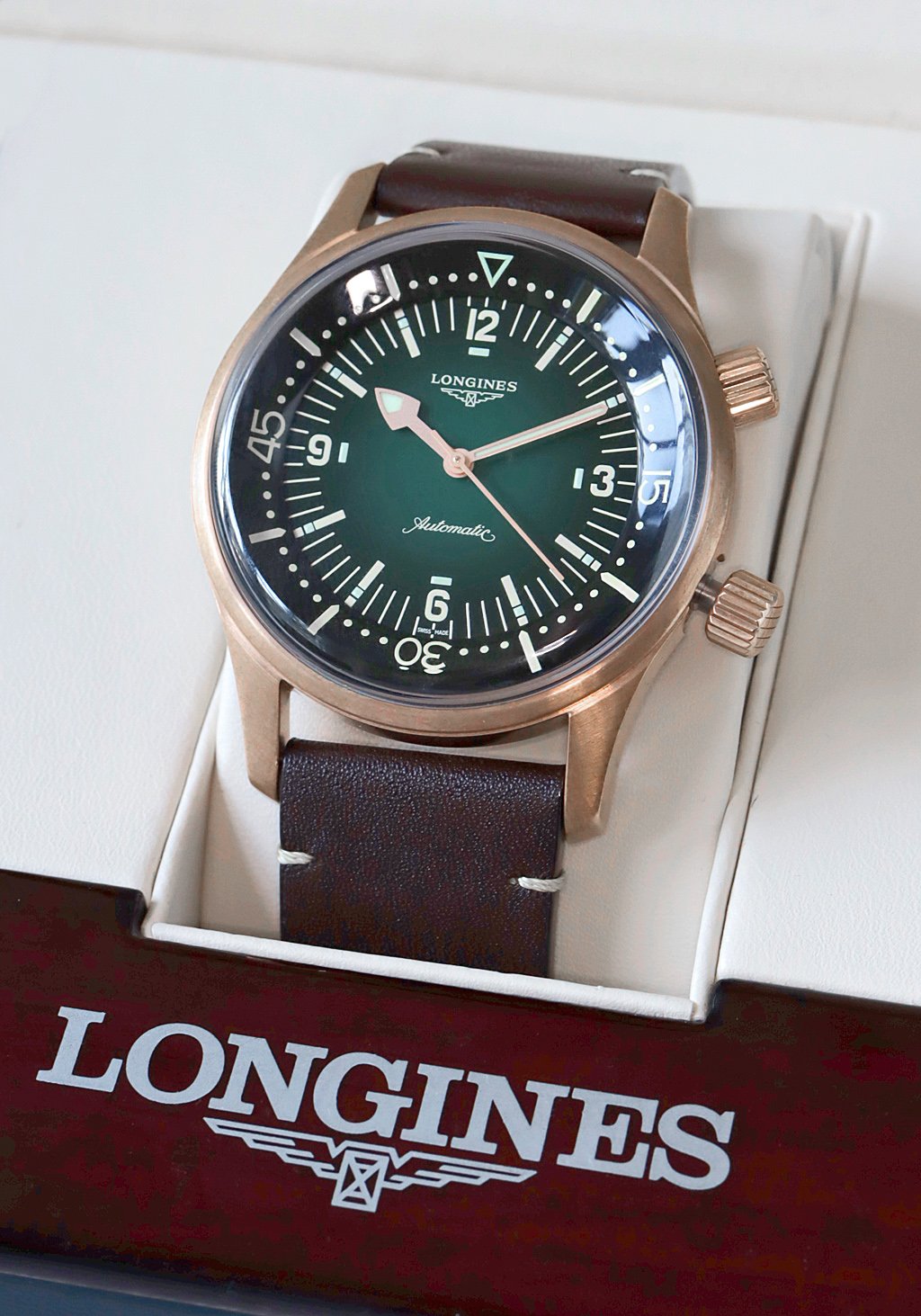
An internal bezel is a timing ring that lives under the crystal, where your fingers cannot reach it. Instead of gripping the ring itself, you turn it with a second crown, usually sitting at 2 o’clock while the normal crown handles time-setting at 4. It looks like a design flourish. It started as an engineering answer to a real problem.
The problem was water. In the 1950s, a rotating bezel sat outside the case, exposed to knocks, grit, and salt. A ring sealed under the crystal could not be jammed by sand or ripped off on a hatch, and it did not compromise the case the way an external moving part might. The solution needed a case that could handle two crowns without leaking, and that is where a small Swiss case maker called Ervin Piquerez SA, usually shortened to EPSA, comes in.
Piquerez patented the Super Compressor case in 1953. The name describes the trick: the case back was designed so that increasing water pressure pressed it tighter against its seal, meaning the deeper you went, the better it sealed. You can spot a Super Compressor at a glance by its twin crowns, both wearing the same cross-hatch pattern like tiny waffle irons. EPSA did not sell watches under its own name. It sold cases to everyone: Jaeger-LeCoultre, Longines, IWC, and a long list of smaller brands all shipped divers in EPSA cases. If you have ever wondered why so many 1960s dive watches look like cousins, this shared case supplier is a large part of the answer.

A Longines Legend Diver in bronze. The dive-time ring sits under the crystal, rotated by the crown at 2 o’clock. Photo: Wikimedia Commons (Minzoblate), CC BY-SA 4.0.
The Longines Legend Diver, introduced in 1959, is the purest expression of the idea. It is a Super Compressor diver with a clean dial, an internal 60-minute ring, and those two cross-hatched crowns. Longines reissued it in 2007, and the reissue turned out to be one of the most successful heritage revivals in the business, which tells you the look had been quietly missed.
Jaeger-LeCoultre got to the internal ring from a different direction: the alarm. The Memovox E855, from 1959, was an automatic alarm watch, and it used a rotating inner ring to set the alarm time. You can see the triangular marker at the bottom of the dial in the photo below; that triangle belongs to the ring, and the upper crown moves it to the hour you want to be woken at. Then came the Memovox Polaris in 1968, JLC’s Super Compressor dive watch, which combined the alarm, the internal rotating bezel, and triple case-back construction into one watch. It is one of the coolest tool watches ever made, and it took the market about forty years to notice.

A Jaeger-LeCoultre Memovox E855. The triangle marker at 6 belongs to an internal ring, moved by the upper crown, that sets the alarm. Photo: Wikimedia Commons (Ghilt), CC BY-SA 3.0.
Operating one takes a moment to learn. The upper crown rotates the ring, usually in both directions, and because it is geared rather than clicked, it moves smoothly without the ratchet feedback of an external bezel. That smoothness is a feature and a small frustration: precise alignment takes a steadier hand than slamming a Submariner bezel to the pip. You also cannot adjust it with gloves on while actually diving, which is one reason the external dive bezel eventually won the professional argument.
And yet the internal bezel never died. It survived because it looks good. A watch with an internal ring has cleaner lines than one with a chunky external bezel, and the twin-crown layout gives the case a pleasing symmetry. Longines still builds the Legend Diver more or less as it was. JLC revived the Polaris line in 2018 with the internal bezel intact. Plenty of microbrands have copied the formula. The engineering justification faded decades ago; what remains is a style that people reach for because it feels considered and a little unusual, like choosing the manual transmission.
Why it matters
Internal bezels matter because they are a reminder that tool watches were once a genuine engineering contest, with different companies solving the same problem in completely different ways and the best solution not always winning. The external bezel won on practicality, but the internal ring won on elegance, and elegance turned out to have a longer shelf life. If you like the look of twin crowns, you are responding to a 1950s solution to a problem most of us will never have, and there is nothing wrong with that. Most of the best things about mechanical watches work exactly this way.
Thanks for reading this.

