
In 1972, Audemars Piguet launched a sports watch made of steel and priced it at 3,300 Swiss francs, which at the time was more than a lot of gold watches cost. The watch was the Royal Oak. It had an octagonal bezel held down by eight visible hex screws, a steel bracelet that flowed straight out of the case with no lugs in between, and a blue dial with a stamped waffle pattern. It was designed by a freelance designer named Gérald Genta, and it looked like nothing else in the building. Sales started slowly. History, eventually, caught up.

The Patek Philippe Nautilus ref. 3700/1A, Genta’s 1976 follow-up to the Royal Oak. Photo: Wikimedia Commons, CC BY-SA 4.0.
Genta’s overnight sketch
The famous story is that AP’s managing director Georges Golay called Genta the evening before the 1970 Basel fair opened and asked for a steel sports watch that had never been done before, and Genta sketched it overnight. The brand has never discouraged this telling, and my read is that the truth matters less than what the story reveals: nobody involved expected the design to work. The Royal Oak was 39mm wide at a time when 36mm was large, and its caliber 2121, a 3.05mm-thin automatic built on a Jaeger-LeCoultre base, let the whole watch sit just 7.2mm thick. Golay reportedly ordered 1,000 steel cases before the launch, which for a company AP’s size in the middle of the quartz crisis was either visionary or reckless, and in hindsight gets to be visionary. The brand says the octagonal bezel was inspired by a ship’s porthole and by diving helmets, and the name comes from Royal Navy ships, which themselves were named for the oak tree Charles II hid in. That is a lot of storytelling for eight screws, but it has worked for fifty years.
The Nautilus answers
Four years later, Patek Philippe hired the same designer and got its own steel sports watch: the Nautilus ref. 3700/1A, launched in 1976. The Nautilus was even bigger at 42mm, with a rounded octagonal bezel, little hinge-like “ears” on the case flanks, and a two-part case construction that Patek Philippe says was inspired by ocean liner portholes. It was rated to 120 meters, which was genuinely impressive water resistance for 1976, and it ran on the caliber 28-255 C, another ultra-thin automatic from the same Jaeger-LeCoultre family as the Royal Oak’s movement. Patek ran ads calling it “one of the world’s costliest watches made of steel,” which was the whole pitch. The metal was ordinary. The audacity was not.
What “integrated” actually means
Strictly speaking, an integrated design means the bracelet was designed with the case as a single unit: no lugs, no gaps, the metal flows from the watch head into the links as one continuous shape. You cannot swap it for a leather strap without a custom-made part, which is the honest mechanical test. Genta was the master of this. Beyond the Royal Oak and the Nautilus he designed the IWC Ingenieur SL in 1976, another integrated steel design, and his fingerprints are on the Omega Constellation and the Cartier Pasha too. Piaget went its own way with the Polo, launched in 1979 as an integrated gold sports watch for the jet set, all polished curves and no pretense of tool-watch toughness.

The Piaget Polo S, a modern take on the integrated bracelet sports watch. Photo: Wikimedia Commons, CC BY-SA 4.0.
The modern craze
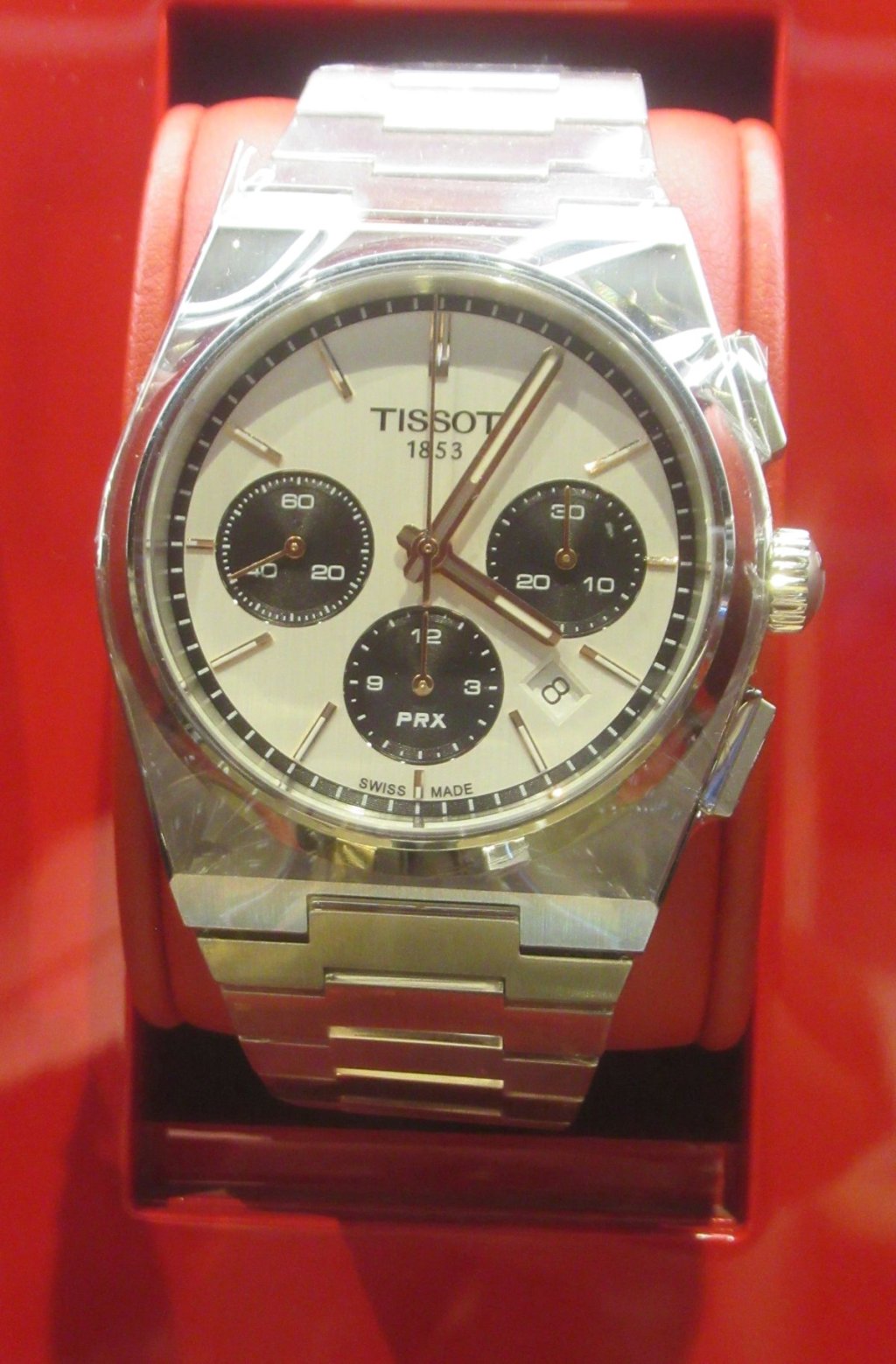
For a decade or so now, “integrated bracelet” has been the hottest phrase in watch marketing, and the market has been flooded with watches that wear the look: the Tissot PRX (a reissue of a 1978 design), Christopher Ward’s The Twelve, the Frederique Constant Highlife, the Maurice Lacroix Aikon, the Zenith Defy Skyline. Some of these are genuinely well designed. But honesty requires saying that most of them are a style trend wearing the vocabulary of the 1970s originals. A bracelet with shaped end links that hug the case is not the same thing as a case and bracelet designed as one piece, and plenty of “integrated” watches today are really just lugless watches with good end links. If you have spent any time in the hobby, you have seen this movie before: a good idea becomes a category, the category becomes a trend, and the trend becomes a word that means whatever the ad copy needs it to mean.
Why it matters
The integrated design matters because it is the moment steel became respectable. Before the Royal Oak, luxury meant gold and small; after it, a steel watch could cost more than a gold one and nobody laughed, or at least they stopped laughing eventually. Genta’s two great designs taught the industry that the bracelet is not an accessory to the watch, it is part of the watch, and every integrated bracelet since is living in the shadow of that idea. Just check whether the shadow has any substance before you pay for it.
Thanks for reading this.

