
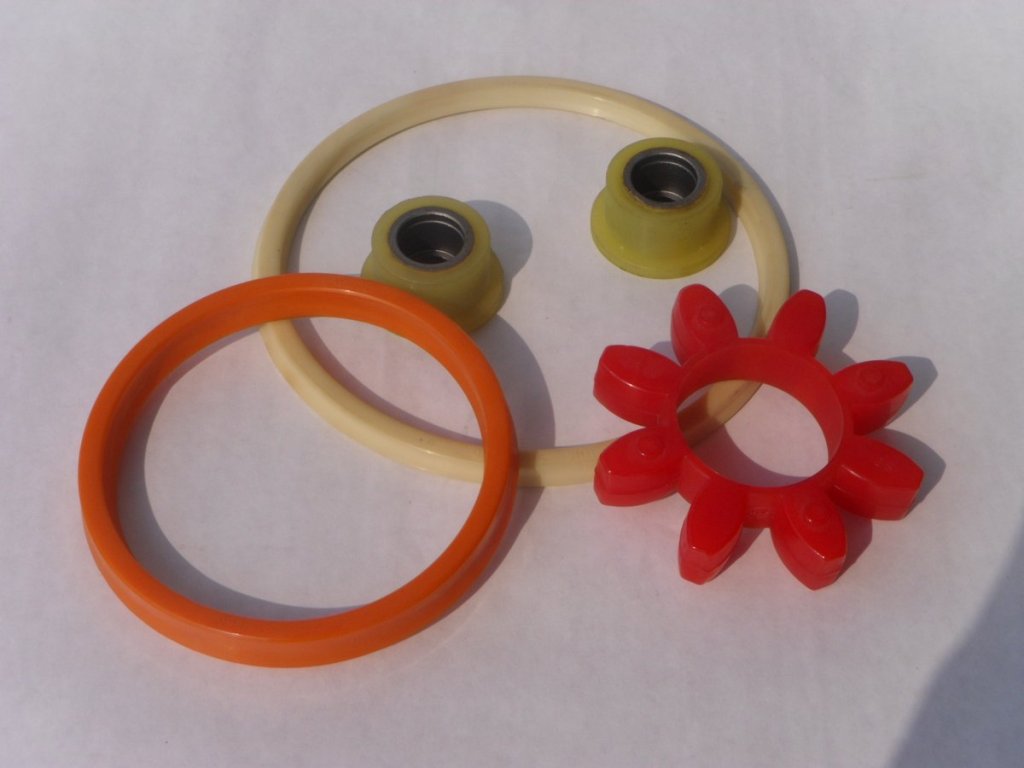
Every water-resistant watch you own is kept dry by rubber rings you will never see, each one worth a few cents, and every one of them is quietly dying from the day it is installed. The gasket is the least glamorous part in all of watchmaking. It is also, without exaggeration, the part that stands between your movement and the ocean.

Crown and pushers, and every one of them has a gasket behind it. Photo: Wikimedia Commons, CC BY 4.0.
O-rings and flat seals
There are two basic shapes. The O-ring is exactly what it sounds like: a torus, a little rubber donut, usually black, that sits in a groove and gets compressed when two parts are screwed together. The flat gasket is a thin ring of rubber that gets squeezed between two flat surfaces, most commonly under the caseback. Both work the same way: rubber is elastic, the metal parts are not, and squeezing the rubber into the gap between them leaves water with nowhere to go. The materials are synthetic rubbers, and the three you will hear about are nitrile (also called Buna-N or NBR, the workhorse, cheap and oil-resistant), silicone (softer, handles temperature extremes, common in higher-end seals), and Viton (a fluoroelastomer, the Chemours trademark, prized for chemical resistance). Nitrile was developed in Germany in the 1930s; synthetic rubber as a category is a postwar story, and modern water resistance is really a postwar story too.
Where they sit
Count the holes in your watch and you have counted the gaskets. There is one in the crown tube, compressed every time you screw the crown down, which is why an unscrewed crown is an open door. There is one under the caseback, the big one, doing most of the work. There is one around the crystal, front and sometimes back. If it is a chronograph, each pusher has its own small seal. Dive watches add more: the helium escape valve, if it has one, needs sealing, and so does every rotating bezel assembly worth trusting. A modern dive watch can easily contain half a dozen separate seals, and the water resistance rating is only as good as the weakest one. Which brings us to the bad news.
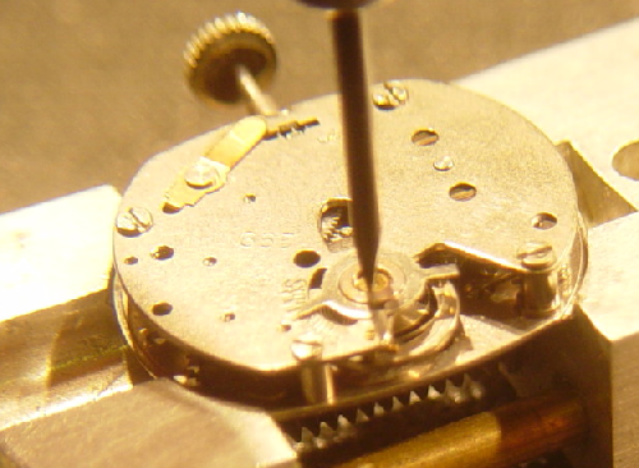
A watch opened for service, when every gasket should be inspected. Photo: Wikimedia Commons, CC BY-SA 4.0.
Why they fail
Rubber does not last. It dries out, it takes a permanent compression set (meaning it stops springing back), and it is attacked by heat, ultraviolet light, chlorine, salt, soap, and time itself. A watchmaker will coat new gaskets in a thin film of silicone grease at service, which helps them seat and slows the drying, but it is a delaying action, not a cure. The standard advice, and my read is that it is genuinely good advice rather than upselling, is to have the seals checked and the watch pressure tested every couple of years if it sees water, and to replace the gaskets at every full service. Critically: any time the case is opened, for anything, even a battery change, the watch should be pressure tested afterward. Opening the case disturbs the seals, and careful reassembly does not change the physics of that.
A short history of keeping water out
Before synthetic rubber, waterproofing was somewhere between craft and wishful thinking, with cork and lead seals doing their best in pocket watches that were never really waterproof. The Rolex Oyster of 1926 was the breakthrough that mattered: a screw-down caseback and a screw-down crown that compressed the seals with real, repeatable force, turning waterproofing from luck into engineering. Everything since has been refinement of that idea. Better rubbers, tighter tolerances, more seals, deeper ratings. The fundamental deal has not changed in a century: squeeze rubber between metal, keep squeezing it, and replace it before it gives up.
Why it matters
The gasket matters because it is the cheapest part of your watch doing the most consequential job, and it is the part nobody thinks about until it fails. A ten-cent O-ring is the difference between a dive watch and a very expensive paperweight full of seawater. Respect the rubber. Grease it, replace it, test it, and never trust a seal you cannot remember installing. The ocean is patient, and it only has to win once.
Thanks for reading this.

