
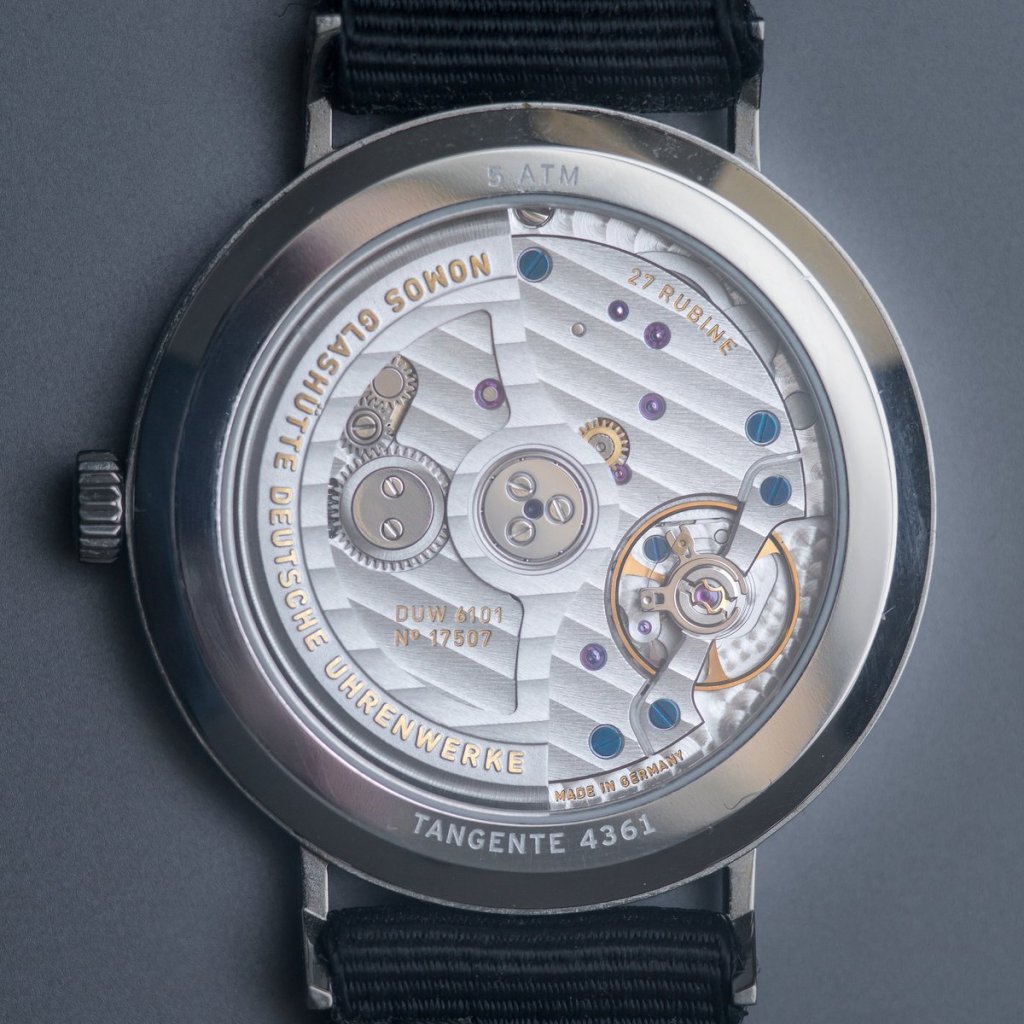
A window in the back
An exhibition caseback replaces the solid metal lid with a sapphire crystal window, usually set into a metal ring, so you can watch the movement work. Flip the watch over and there it is: the rotor swinging, the balance wheel breathing, the gears turning. It turns the back of the watch into a second dial, except this one tells you about the machine instead of the time.
The idea is older than it looks. Glazed display backs existed on pocket watches, where dealers and watchmakers used them to show off a movement without opening the case. For wristwatches, the experiments started in the 1970s and 1980s, when synthetic sapphire became practical for watch crystals, and the real craze arrived in the 1990s with the mechanical renaissance. Brands were finishing movements beautifully again, hand beveled edges, Geneva stripes, engraved rotors, and a solid back hides all of that. The sales logic was hard to argue with: if the customer is paying for decoration, let the customer see the decoration.

The Zenith El Primero 36000 VpH Tribute to Charles Vermot, showing its movement through a sapphire exhibition caseback. Photo: Wikimedia Commons, CC BY-SA 3.0.
The trade-offs
A display back costs you things, and brands are quieter about this part. It makes the watch thicker: the crystal, its gasket, and the retaining ring all stack up under the movement, which is why thin dress watches with display backs are often not as thin as they could be. It adds another seal, which is another place water can get in, so serious dive watches mostly skip it. And it interrupts the magnetic shielding a traditional soft-iron inner case provides. Those inner cases normally enclose the movement from several directions, including behind the dial and caseback, which is why many traditional antimagnetic watches use solid backs. Modern manufacturers can achieve substantial magnetic resistance through alternative materials and movement construction instead. Physics does not negotiate.
There is also the servicing angle. A display back is one more crystal to scratch, and a scratched caseback crystal is somehow more annoying than a scratched front crystal, because you chose this. You asked for the window. Now you get to look through your mistakes.
On the other side of the ledger: it is genuinely delightful. Watching a rotor swing and a balance oscillate never quite gets old, and for a lot of people it is the thing that turned a watch from an accessory into a fascination. An aftermarket industry exists to prove the point. The famous photo of the Omega caliber 321 movement, the Moonwatch caliber, was taken through an exhibition caseback made by Thomas Preik, an independent maker, because Omega itself shipped those watches with solid backs. Owners wanted to see the movement badly enough to pay someone else to cut a window in. That tells you everything about the demand.

The alternative: a solid caseback. Slimmer, tougher, and historically correct for tool watches. Photo: Wikimedia Commons, CC BY-SA 4.0.
Why collectors still argue about them
The argument never ends, and it has two honest sides. The display back camp says a mechanical watch is a machine worth looking at, that finishing you cannot see is finishing wasted, and that flipping your watch over at a red light is one of the small joys of the hobby. The solid back camp says the watch is for telling time, the back is for keeping water out, and a display back is a thick, fragile gimmick that exists to sell watches to people who like looking at gears.
My read is that both camps are describing real preferences, and the tell is what kind of watch it is. On a hand finished dress watch with a beautiful caliber, a display back is the whole point; hiding that movement would be perverse. On a dive watch or a field watch, a display back is working against the watch’s job, and the solid back is the honest choice. The argument gets silly only when people treat it as a rule instead of a trade-off.
Why it matters
Exhibition casebacks changed what a movement is for. Once the back became a display case, movements started being designed to be looked at: decorated rotors, finished bridges, layouts arranged for the view from behind. There is nothing wrong with that, but it is worth knowing that the pretty movement in your watch may be pretty partly because you were expected to stare at it. The window did not just reveal the movement. It changed it.
Thanks for reading this.

