
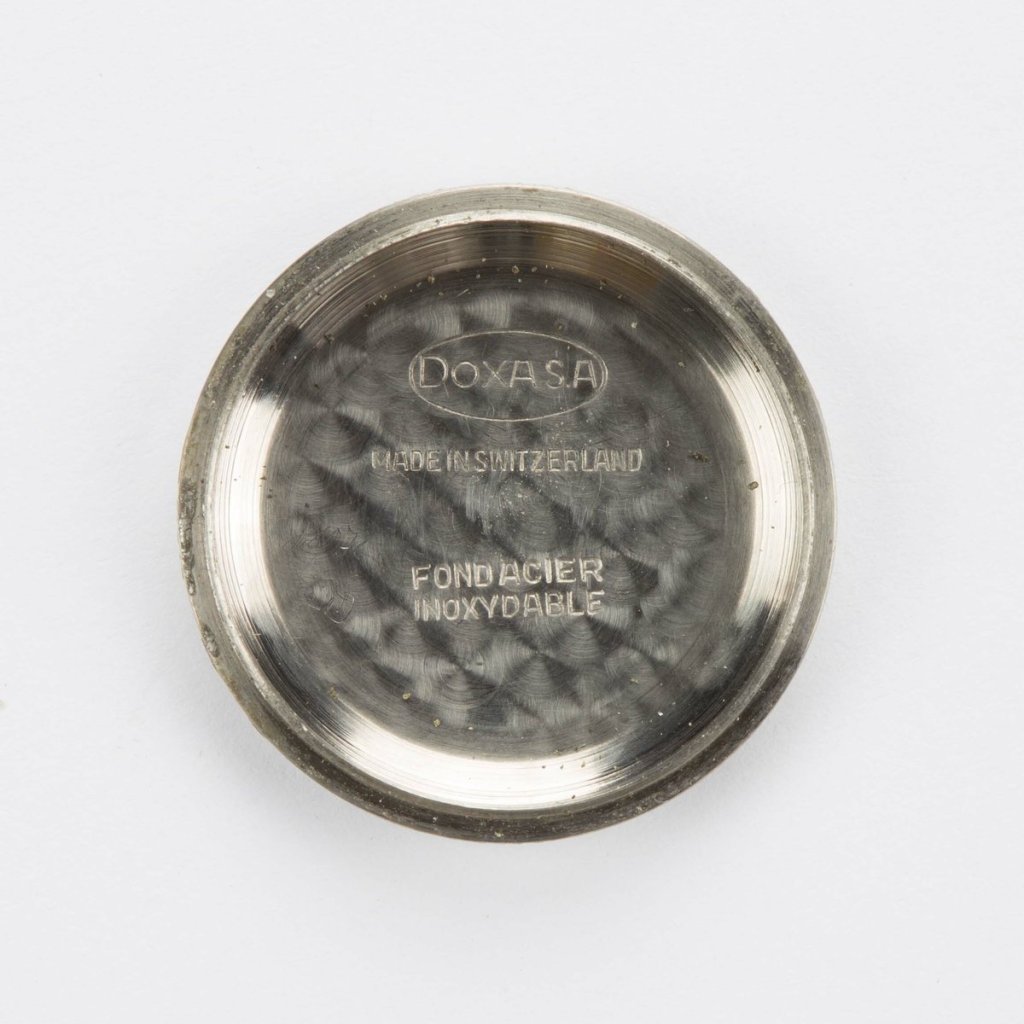
The back of the watch
The caseback is the lid on the bottom of the watch. You never look at it while wearing the watch, which is exactly why collectors obsess over it. The caseback carries the engravings that document what a watch is: the brand, the reference number, the serial, the water resistance rating, and sometimes a whole history stamped into the metal. It is the watch’s paperwork, permanently attached.
Casebacks come in a few attachment styles, and the style tells you a lot about the watch. A screw down back threads into the case with notches or flats for a case wrench, and it is the choice for anything that takes water seriously. A snap off back, also called press fit, is pried open with a knife blade and held by friction, common on dress watches where thinness and simplicity matter more than sealing. Screw fixed backs are held by small screws around the edge, seen on vintage military watches and some modern tool pieces. Pocket watches had hinged backs, and a few wristwatches inherited that idea, but hinges are mostly history now.

A screw-down caseback carrying its engravings: brand, reference, and ratings, all stamped where they cannot fall off. Photo: Wikimedia Commons, CC BY-SA 4.0.
Engravings and their history
The engraving on a caseback is often the most honest part of a vintage watch, because it was put there for bureaucrats and soldiers, not for collectors. During the Second World War, the British Ministry of Defence issued the “Dirty Dozen” watches: twelve Swiss brands making wristwatches to a military specification, each with WWW (for “wrist, watch, waterproof”) and a broad arrow property mark engraved on the caseback. Those marks were inventory control, not romance. They became romance later, when collectors realized the engravings proved what the watch was and where it had been.
Presentation engravings are the civilian version: “Presented to Frank for 25 years of service,” that kind of thing. They tell you the watch was a gift, which is charming unless you are Frank’s family selling it, in which case the engraving is a small discount on the price. Collectors are divided on these. Some find them human and wonderful. Others find them to be someone else’s memories carved into their watch. Both are right.
A word of caution from the world of fakes: engravings are easy to add and hard to verify. A military issue mark on a caseback is only as trustworthy as the rest of the watch, and plenty of ordinary watches have been “upgraded” with a plausible story stamped into the back. My read is that an engraving should confirm what the watch already tells you, not be the only evidence.
Why solid casebacks still matter
In an era of display backs, the solid caseback can look like the boring option. It is not. A solid back makes the watch slimmer, because there is no crystal and retaining ring adding thickness underneath. It makes the watch tougher, because steel shrugs off knocks that would crack sapphire. And it is historically correct for tool watches: a 1960s dive watch or field watch had a solid back, full stop, and putting a display back on a reissue of one is a modern compromise dressed up as a feature.
There is also the antimagnetic argument. Some watches protect their movements with a soft-iron inner case that acts as a magnetic shield, and that shield needs to enclose the movement completely. A window in the back is a hole in the shield. So the serious antimagnetic watches keep their solid backs, not out of nostalgia but out of physics.

A tool watch with nothing to show on the back and nothing to prove. Solid backs are slimmer, tougher, and historically honest. Photo: Wikimedia Commons, CC BY-SA 4.0.
Why it matters
The caseback is where a watch’s claims meet its construction. The attachment style tells you how water resistant it really is, the engravings tell you what it is and sometimes where it has been, and the choice between solid and display tells you what the watch values: toughness and thinness, or showing off. Flip your watches over more often. The back is usually telling the truth even when the dial is flirting with you.
Thanks for reading this.

