Almost every watch is round. That is the first fact about case shapes, and it explains most of the rest. The wristwatch inherited its shape from the pocket watch, which was round because movements were round and pockets were round, and for the first decades nobody saw a reason to argue with it. Every other shape exists because somebody, somewhere, decided round was boring.

The Cartier Tank, the rectangular watch that defined the shape for a century. Photo: Wikimedia Commons, CC BY-SA 2.0.
The rectangle: Tank and Reverso
The most famous non-round watch in history is the Cartier Tank. Louis Cartier designed the prototype in 1917, the brand says, taking inspiration from the Renault FT tanks rolling across the Western Front, and the standard telling has the first one going to General Pershing, commander of the American Expeditionary Force. Commercial production began in 1919, and the design has barely changed since, because there was never anything to fix. For a century it has been the benchmark every other rectangular watch gets measured against, worn by everyone from Andy Warhol (who reportedly never wound his) to Princess Diana, and it made the wristwatch acceptable for men at a time when wristwatches were still considered women’s jewelry.
The other great rectangle is the Jaeger-LeCoultre Reverso, born in 1931 from a genuinely practical problem. British polo players in India kept smashing their watch crystals with mallets, so a Swiss businessman named César de Trey commissioned a case that could flip over and present its steel back to the world. René-Alfred Chauvot filed the patent, Jaeger-LeCoultre supplied the movements, and the Art Deco rectangle with its sliding, reversing carriage became an icon. The Reverso is a sports watch the way a vintage Porsche is a sports car: it was born for a game nobody plays in it anymore, and it survives on the strength of the idea.

The Jaeger-LeCoultre Reverso, a rectangle built to flip. Photo: Wikimedia Commons, CC BY-SA 4.0.
Tonneau, cushion, and oval
The tonneau, French for barrel, is the shape with a curved, bulging profile: Cartier‘s Tortue of 1912 and Patek Philippe‘s Gondolo, made in the early 1900s for the Rio de Janeiro retailer Gondolo & Labouriau, are the classic examples. It reads as elegant and slightly old-fashioned, which is exactly the point. The cushion case is the tonneau’s tougher cousin, a square with soft, pillowy corners. Panerai owns this shape in the modern imagination through the Radiomir and Luminor, but early Rolex Oysters were cushions too, back when a watch case just needed to hold a movement and survive. The oval is the shape’s quiet luxury branch: Cartier’s Baignoire, dating to 1912, is essentially an ellipse, and it has been worn by people who would never be caught dead in anything loud.
The weird ones
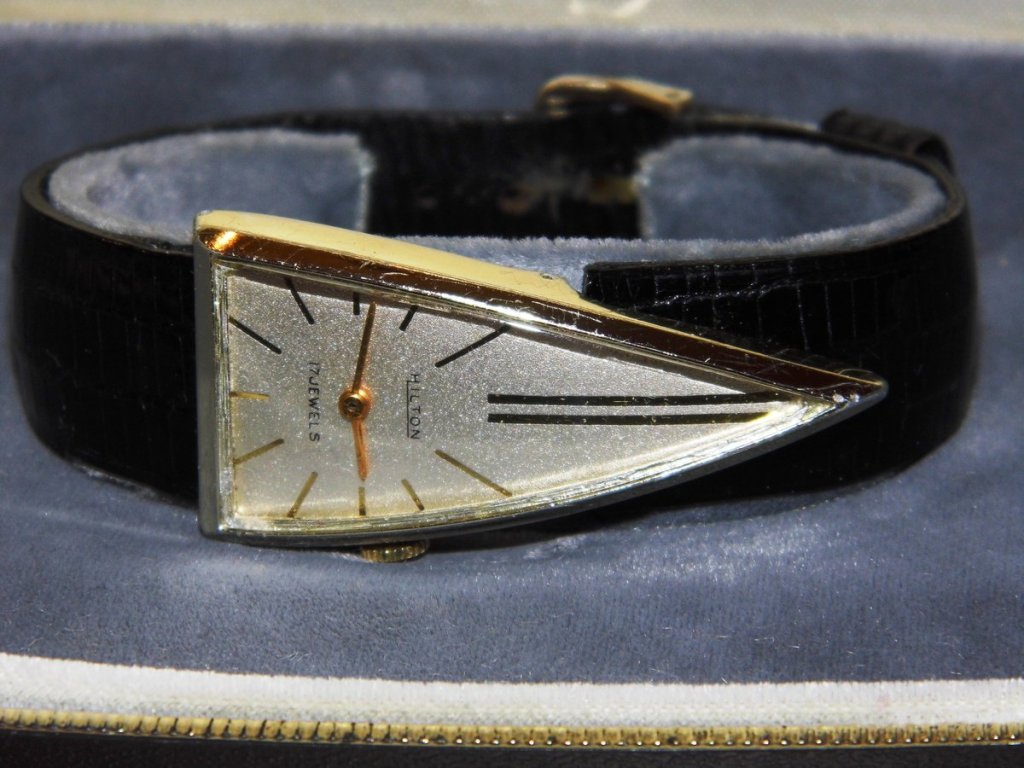
Then there are the shapes that were never supposed to be practical. The 1960s produced a run of asymmetric cases, the most famous being the Hamilton Ventura of 1957, designed by Richard Arbib with a shield-like case that looks like it is doing 90 in a school zone. It was also the first electric watch, which meant the weirdness was doing double duty. Asymmetry mostly stayed a 1960s experiment, resurfacing occasionally when a brand wants to signal that it is having fun. My read is that the market tolerates exactly one or two weird shapes at a time, and the Ventura got there first and never really left.
A Panerai with the cushion case the brand made its own. Photo: Wikimedia Commons, public domain.
Shape as signature
This is why shape matters more than most spec sheets admit. A round watch can be anybody’s; a Tank is Cartier’s, a Reverso is Jaeger-LeCoultre’s, a cushion is Panerai’s, a tonneau with the right proportions whispers Patek. Brands spend fortunes trying to own a shape because it is the one thing a customer can recognize from across a restaurant. Round will always be the default, and the default is fine. But the shapes that survived a century did it by being somebody’s on purpose.
Why it matters
Case shape is the fastest way a watch tells you who made it and what it thinks of itself. Round says tradition. Rectangular says you have read a book. Cushion says you would like people to think you dive. Every shape on this page was a gamble when it launched, and the ones still around won the gamble so completely that we forget it was ever a risk. Next time a watch catches your eye from across the room, notice the shape first. That was the whole idea.
Thanks for reading this.

